Fioretto Sprouting Cauliflower

2021: WHAT A SUMMER!

The GARDEN SUMMER of 2021 was fabulous. Great weather, abundant harvests & no rodents made it a hit in my book. This year the pasture grasses stayed greener longer, the wildflowers flourished, and there were a good deal more ladybugs in the garden (and very few grubs).

Maybe next year I’ll get to the point of knowing just what to start when, and how much of each thing at a time. There were a few too many of some things and not enough of others. I’m getting much better at that each year, and if I follow through on this year’s notes next year, I should be good to go.

HIGHLIGHTS
FIORETTO SPROUTING CAULIFLOWER: I’m really glad I found this sprouting cauliflower. I like this better than the regular crown type of cauliflower: it is much sweeter and delicious simply steamed. Some of them were beautiful & picture perfect like the one in the photo, others rather scraggly in appearance, but all of them were just as tasty no matter what they looked like.

ONIONS: I started more onions much earlier than before, first in soil blocks under lights then transplanted to the greenhouse prior to going outside. All-in-all they did quite well in numbers, but still small-to-medium in size. I admit I planted them a little closer together than recommended, but perhaps in these conditions they just won’t get any larger. The more the merrier.

GREEN BEANS (BUSH): This year I grew the same bush beans, SPEEDY, and they over-performed. I might say that I have too many, but frozen beans are great and the freezer full of beans will provide many green bean casseroles along with just plain ole’ steamed green beans as a side. The lady bugs may have helped to keep the aphids off!

CELERY: This was my best celery year so far. I did a different variety this year, TANGO, so perhaps that contributed to the success. I also gave them a better start in the greenhouse prior to going outdoors. Too bad they don’t store very long and I don’t eat that much.

SQUASH: ZUCCHINI & the SMALL WONDER SPAGHETTI Squash were plentiful. See my newest favorite zucchini recipe HERE. The CELEBRATION harvest was fewer and BUTTERBUSH not so great. I won’t be doing Butterbush again.

BRASSICAS: In addition to the Fioretto, all the brassicas did well, as usual. No surprise there. We had lots of broccoli & broccolini, cauliflower, cabbage, brussels sprouts and rutabagas. I grew a bit too much cabbage & too many rutabagas, but next year I should get the amount more suited to my needs.

OTHER than the above, peas, lettuces, carrots, parsnips & beets all did well.

DISAPPOINTMENTS
GARLIC: I thought I may never bother with garlic again. The seed garlic I usually purchase through mail order is expensive, and the yield I get isn’t worth the cost. This year I planted 26 cloves and harvested just NINE wimpy little bulbs. Perhaps the winter was colder, or because I planted the garlic on one of the outer, perimeter shadier beds it got colder. I’m not sure. None of the garlic at the edge of the bed grew, only the inner row, and not all of those. I got some sale garlic this year, so I’m trying just one row in one of the inner beds, well protected in the center of the bed.

2021 Potatoes

POTATOES: This year the potato plants certainly flourished, as seen in the photo, but unfortunately the yield wasn’t so great. This year I planted Chieftain (red) and Caribou (russet) potatoes. Both varieties were small in number and in size, but in good shape & delicious. Perhaps the trial planting method this year inhibited their growth. I tried placing the seed potatoes ON TOP of the soil, covering them with many layers of mulch, but apparently that didn’t work as well as promised.

ASPARAGUS: Most of the asparagus that came up this year was very skinny and froze before I had a chance to harvest it, even though it was covered with frost cloth. Not sure what to do about that.

ME: The only other “disappointment” is my inability to eat everything I grow before it goes bad, particularly the things that need to be eaten fresh. I need to do a better job of spacing things out.

GREENHOUSE
The only things grown in the greenhouse during summer months were TOMATOES & WINTER SQUASH which both did decently. I tried a new variety of tomatoes, Cordova, which suffered from some BLOSSOM END ROT & APHIDS, but eventually I managed to control them both to get some nice tomatoes off those plants. Some greenhouse space was planted with cover crops or let to rest. I really don’t need anything else in the greenhouse during the summer, and the rest period is good to prepare for a busy winter of growing.

COLD-CLOSET-ROOT-CELLAR
Aside from the garden itself, we’ve found that we can keep our “cold-closet” cold by adding ice to it in late summer after I begin harvesting root veggies and before the nights are cool enough to keep it cold. Now that our electricity is solar, we don’t pay any extra to use the freezer space for freezing ice. Several water bottles frozen and swapped with another batch of frozen bottles every other day or so kept the cold closet around 45 degrees beginning the end of August when we needed it for beets & rutabagas. (Next year I plan to start the ruties & beets later in the summer for a later harvest, thus enabling them to store longer into the winter.)

FALL & WINTER

GREENHOUSE: For fall & winter the greenhouse is filled with tomatoes, lettuce, spinach, zucchini, cabbage, broccoli & cauliflower. I’ll be saving space for my “onion nursery” to begin in February, like last year.

OUTDOORS: The last of the potatoes, carrots & parsnips were harvested before the ground froze, mid-November. Most of the beds have been put to rest by topping them with compost which was made throughout the summer & fall. The remaining beds will wait for compost early in the spring. 

Other than that, winter will hopefully be spent updating all of the vegetable pages here with growing instructions and recipes.

And playing radio!
LaurieInShack

A COUPLE OF HAMS

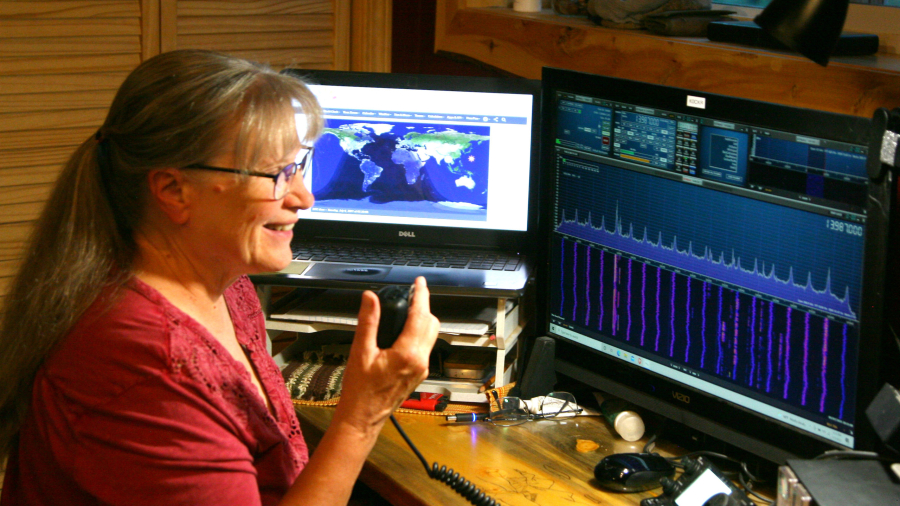
We have recently become Ham Radio Operators, working from our shack here at home. Now that we are off-grid, Tim got to thinking that hams can be very helpful with communications during emergency situations such as wildfires or winter storms. When there is no cell or landline phone capability, no internet and no power, hams can still operate with radio waves as long as they have power. WE’VE GOT POWER when all else fails, and now that we are hams we can communicate with the outside during these emergency situations. To see how hams can help in this way, here’s a video of Walter Cronkite speaking of ham radio’s contributions in a wildfire that was not far from here several years ago. 

TIM (KØCKR) was a ham starting in 1979 when he first took the test & got his license. He maintained the license until he let it expire in 2009, when he had no radio and wasn’t interested in sticking with it at that time. He recently decided to renew his license (which required taking a test) and get a radio. 

LAURIE (KØLTH) became interested in the hobby as Tim was studying for his test. When I (Laurie) told Tim I was interested, he was quite surprised. He just hadn’t thought I might want to learn all the electronics & radio wave information necessary to operate as a ham. I’ve never done anything like this before, and it was quite a challenge to do the studying in preparation and then take the exams. 

For those who don’t know, there are different levels of ham operators. TECHNICIAN is the beginner class: Technicians are only allowed to operate on a small number of very high frequencies. The GENERAL class is the next step up. Generals can operate on many more frequencies, considered “high frequency” radio bands.

Tim and I are both “Generals”. Since Tim had previously been in the 2nd level, he only had to take the Technician exam and was then “grandfathered” in to the General classification. As a new licensee, I had to take both the Technician and General exams. I studied hard and took both tests on the same day. I was very pleased to pass both tests!

Shortly after Tim got his renewed license, we got a radio (transceiver) and antenna and began listening to and transmitting out to some local repeaters. These repeaters are put up by local clubs to help transmit locally. With all the mountains around, line-of-sight transmission is difficult. These repeaters take ham signals and retransmit them all around the local area. It’s kind of like a “party” line. Everyone on the repeater hears what everyone else is saying. We’ve joined one of the local ham radio clubs and have begun meeting a few of the people we are hearing over the repeater. The main topics of discussion for most of these hams are antennas, radios, how strong their signal is, and so on. Some of them do various contests to see how many people they can contact and how far away they are. Some of them participate in climbing to mountain tops and seeing how many people they can reach using line-of-sight, and how far these people can receive their signal.

In addition to local communication, we are now able to receive & transmit all around the world. It’s amazing how these radio waves work! One thing that’s great about our location is that we have plenty of room on our 40 acres for antennas, and no homeowner restrictions to keep us from putting them up. A couple of weeks ago a friend came to help us put up a temporary “dipole” antenna (just a couple of wires strung between two trees and hooked together. This allowed us to hear and communicate with people all over the states, and even Italy and Slovenia!

Horizontal Loop antenna follows these lines through the trees.

In the past couple of days Tim and I put up a “horizontal loop” antenna, which is a loop of wire about 300 feet long attached to six of our pine trees. The loop is about 35-40 feet high. This will now allow us to transmit on many more bands, all around the world. It was rather challenging to get it up into the trees that high, but we did it (well, mostly Tim–I helped). 

Ladder Line connects horizontal loop to radio
Loop of wire extends over the garden

Perhaps in the future there will be more updates on our ham experiences. We look forward to meeting more people and becoming available to help with communications in emergency situations.

**UPDATE!** 
In the past few days I (Laurie) have been able to contact six different countries (including U.S.)! I’ve spoken with other hams in Canada, Russia, Spain, Slovak Republic, and Indonesia. Usually they are short conversations with people trying to make several contacts, but some speak at more length than others. Most hams are men, and they are very interested to hear any woman making contact. Women are called “YL” (Young Lady). A common good-bye said by hams is “73”, meaning “best wishes” or “best regards” or something like that. But many will tell me “88”, which means “hugs & kisses” or something along those lines. It’s a kick.

There has also been a contest going on over the 4th of July weekend by the original 13 Colonies. Each of those states tries to make as many contacts as possible, and they are on the air often. They also are glad to hear a “YL” respond!

Our New Look in 2021

OFF-GRID

THIS IS OUR NEW LOOK IN 2021!

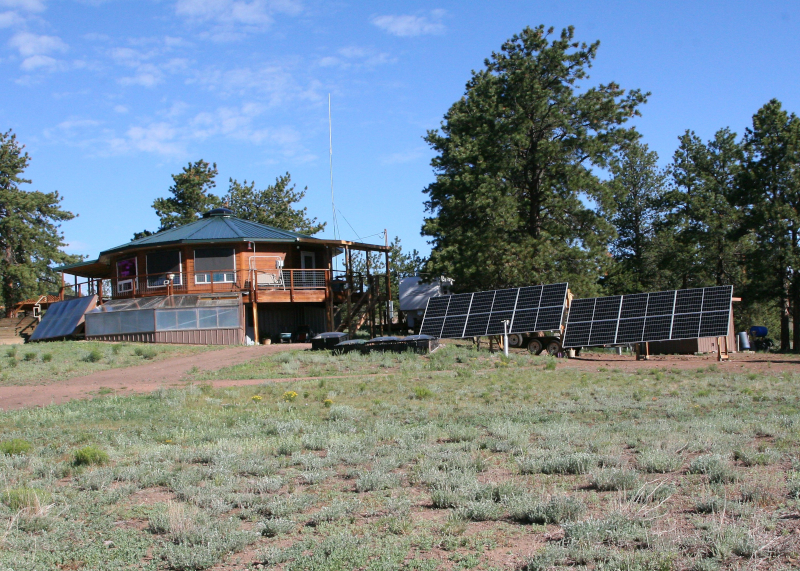
Tim was busy this winter putting in our solar power system, which has been a great addition to our home. The system now fully powers our house, so from now on out we are not dependent on the grid.

After a few months of hard work the project is complete. Prior to starting the project, Tim estimated that we would need 15 kW of power per day. This system provides more than that, and plenty of power to extend through several cloudy days. We are quite pleased with the result. At some point Tim may add a section here on how he did it all. If there is ever time….

We like the solar idea so much we decided to add solar panels to the electric golf cart we use to get around the property to haul tools, garden tools, etc. 

Additionally, he is now just about finished adding a roof over a portion of our back deck and stairs leading to the ground from that side. You can see it to the left of the solar panels. We felt it would be good to have a secondary exit to the ground in case the front exit is somehow blocked.

Our other big project of the year so far is that we have both become ham radio operators. You can see one white vertical antenna extending up at the right side of the house, and we’ve just completed an antenna in the trees behind the solar panels to transmit globally. It’s pretty hard to get a photo of it. Our ham experience is detailed in another post.

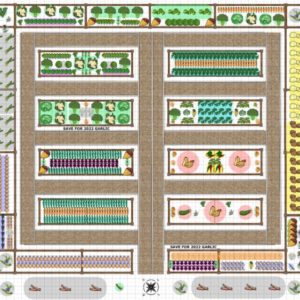
GrowVeg Garden Plan for 2021

2021 GARDEN & GREENHOUSE PLANNING

It’s the end of February, and despite the winter cold, the garden is not far from my mind. The greenhouse has been keeping us supplied with veggies all winter, in addition to what was stored from the 2020 summer garden outdoors. 

OUTDOOR GARDEN

GrowVeg Garden Plan for 2021

My GrowVeg Garden Planner is complete for summer 2021. Some changes are likely to be made, but the plans are in motion, the seeds have been ordered and arrived, the calendar reminders have been set. A few seedlings have already been started.

I have been using this GrowVeg Garden Planner for many years both in my former garden and here in Guffey. GrowVeg has made some changes this year due to the end of Flash Player, and now it’s faster, easier to use, and they’ve made some great changes. I was able to be a beta tester for this new planner, and had a lot of fun trying it out during the later planning stages.

As always, I’ve rotated my crops as much as possible and have planned in advance which beds will be started earlier and which will be later, as well as which will be saved for my 2022 Garlic. This year I will try a few new varieties of veggies I’ve grown before, but no new veggies. As usual, I’m keeping the things that need to be covered the most in the interior beds, as these are the easiest to cover with plastic over the hoops. The perimeter beds are primarily garlic, onions, potatoes, beets & parsnips. The horizontal perimeter beds across the top of the plan receive the most sun in the fall when it is lower in the sky, so I’m planning the crops to be harvested last in that area: my second planting of broccoli, cabbage, cauliflower, brussels sprouts, some spinach, lettuce and carrots. All of these can be harvested after a few light frosts, and the sun will help them warm up to grow as long as possible. 

Tim & I are planning better ways to cover the perimeter beds with frost cloth for those first few weeks when there will likely be frost and a snowstorm or two. Our old frostcloth has gotten rather ratty & mouse-eaten, so we purchased enough new frostcloth to cover just about all the beds. This is in addition to the plastic we use to cover the most susceptible plants in the interior areas.

Hopefully this year we will not have the problems with the mice and pack rats as we did last year. The bait traps Tim had put out really seemed to keep them under control the later part of the summer. By having them in place throughout the winter & spring, we hope to prevent all damage to the garden. We may make a few changes to the way we protect things from the spring cold & snow with better supports for frost cloth and/or plastic, and make it easier to put them out at night and remove them in the morning.

GREENHOUSE
The greenhouse has been growing great! In the fall I planted some broccoli, cauliflower, cabbage, lettuce, tomatoes & zucchini. We’ve really enjoyed eating these fresh from the greenhouse. A couple of my tomatoes have produced the best tomatoes I’ve ever grown in the greenhouse. The Oregon Spring & Siletz tomatoes have been big, meaty, juicy, with few seeds and easy to peel when I don’t want the skins. Since I’ve had such an abundance, I’ve frequently used them for any recipe that uses diced tomatoes or tomato sauce. I think they liked the location (or I did a better job of keeping them fertilized!).

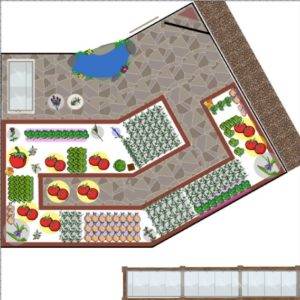
Greenhouse Plan for February 2021

I’ve used the Garden Planner extensively for the greenhouse as well. The “In-Ground Dates” feature in the planner is especially helpful. The photo at the right shows the greenhouse plan for the end of February. With the Planner I am able to show specific plants for each month of the year. Since my greenhouse is used constantly, taking out old plants and replacing the spot with new ones, this really helps me keep track of things and plan ahead. I’m able to start seedlings on my grow bench under lights, preparing them to go in where something else will be removed. At the bottom I’ve added our three cold frames, which may be planted in March with lettuces, spinach, and perhaps some onions to transplant later to the garden.

GREENHOUSE COVER CROPS
This year I’ve felt like I may have been overworking the soil in the greenhouse. Even though I typically refresh the soil by adding compost, vermicompost, aged manure & fertilizers each time something is planted, I fear that is not enough. Without going to the trouble of allowing a long rest period or removing all the soil and replacing it, I’m experimenting with planting some cover crops, some of which are shown in this February plan. I tilled in some well-aged horse manure or some fairly fresh duck manure and a bit of vermicompost, then scattered seeds of mustards, cowpeas, buckwheat & daikon radish. I’m giving them a chance to sprout & grow a bit, then tilling them in. In some cases, I’ve planted pretty soon after tilling these in, but in some of the larger areas I’m experimenting with solarizing the soil by covering the area with clear plastic. The solarizing should heat up the soil and kill diseases which could be in the soil. Hopefully this will only take 2-3 months and should help recondition my tired soil. There should be an update later on how well this goes, but I won’t have actual “data” and will only know by how well the plants grow. As it is said, “Only time will tell.”

ELEVATION

DILEMMA: HIGH ALTITUDE OR HIGH ELEVATION?

WHICH IS IT?

There are many websites and publications that discuss things like gardening or cooking at high elevation or high altitude. Often it seems like the words “elevation” or “altitude” are used arbitrarily and interchangeably. It is certainly inconsistent, even on websites focused on a scientific approach. Since I want to be grammatically correct, I looked it up to be sure.

ALTITUDE is generally used to indicate an OBJECT’s relation to sea level, such as an airplane, hot air balloon, or spaceship.

ELEVATION is generally used to describe a PLACE on earth and its relation to sea level, such as a city, mountaintop, or a home garden.

HERE’S MY DILEMMA
When I talk about the garden, or the act of gardening, am I talking about the PLACE ON EARTH where I’m located, or is the garden or a plant in it, or even the act of working in it, an OBJECT at that point?

Is the act of cooking in it relative to this place on earth, or relative to using an OBJECT such as a pot or pan?

At one time I went through this website and changed every reference to my high location from “altitude” to “elevation”, to be more accurate. Then I realized that most folks search for information about gardening or cooking by using the word, “altitude”, such as “high altitude gardening”.

In the end, I don’t really think there is a black-and-white, right or wrong answer. It really doesn’t seem to matter. The dictionary is not helpful. I’m going to use “altitude” and “elevation” interchangeably, to the best of my knowledge.

August 3, 2020

EVERY YEAR IS DIFFERENT

I’m learning that EVERY YEAR IS DIFFERENT, especially at high elevation. Gardens here present more challenges than those at lower elevation: variable and cold weather, short seasons, new pests & old ones, personal health issues, as well as other factors such as COVID-19 in 2020, which affected seed & garden supply shortages. Fortunately, I had ordered all my seeds prior to the shortages, and I generally have all the other supplies I need on hand.

August 3, 2020

I’m learning to accept disappointing harvests with an attitude of knowing I’m fortunate to have whatever I’m able to harvest, and it’s a lot more than many other folks who don’t put out the effort. I shrug my shoulders and smile, knowing that what disappoints in one year may produce an abundant harvest the next.

2020 was by far the most challenging weather, and our first year to battle with mice & pack rats.
2019 I was still recovering from my hip injury in the spring, but together we planted a full garden. Somehow I did not remember to write a recap of what the garden produced in 2019, but I know there was a bumper crop of potatoes!
2018 I broke my hip in late August and was unable to finish out the garden harvest & winter preparation. (Tim did everything I asked!)
2017 was our first full garden year, with many new things to learn about growing at high elevation.

From now on, each year will be presented in review with weather highlights, pest challenges, new vegetables grown, new varieties tried, and other new things I’ve learned. 

Pack Rats

2020 SUMMER NEMESES

In the past we haven’t had many problems with pests. We thought our garden was pretty much pest-proof. We were pretty sure no deer, bunnies or squirrels could get in. This year we have experienced two new nemeses that kept us busy trying to get rid of them. First, mice. Then their larger cousin, the pack rat. Yeesh! What a year. 

MICE
Early in May, we began to see evidence of chewing on some of the freshly transplanted seedlings, particularly things like the broccoli, cabbage & cauliflower planted in the beds around the perimeter. We’d always known mice would be able to fit in through the stucco netting which surrounds the garden perimeter beds, but we hadn’t experienced problems with them previously. This year they came with a vengeance. We put out bait stations as well as snap traps, and began catching 1-4 mice each night. Eventually there weren’t as many caught, and after the plants were larger, the mice didn’t seem to gnaw on them as much. But, almost nightly we reset the traps and each morning went out to check them, unsnap them, and retrieve any dead mice.

See the damage on this broccoli plant from May 5 after it was damaged, then as it grew back, then close to harvest, July 26.

We got the Tomcat mouse traps, which are a lot easier to set and also to release the dead mice than the traditional wood + spring type trap. You can also purchase some attractant, which makes baiting the traps a bit easier than peanut butter. In addition to the bait and traps, we cut out the bottoms out of several plastic bottles and placed them over the small seedlings to keep the mice out. That worked pretty well, but was an extra chore to place on the plants each night and remove in the morning. In addition to the traps & bottles, we began putting out mouse bait. We no longer cared about how the mice were removed, we just wanted them gone.

PACK RATS
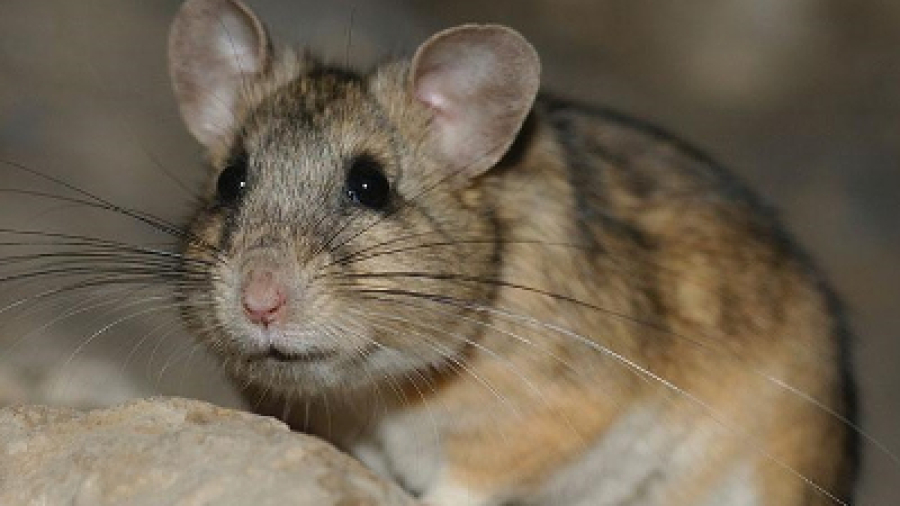
The first inkling that we may have pack rats was May 30th, when I discovered this neatly laid pile of onions next to the onion bed, and these potato stems and cabbage leaves dismembered from their plants. (Fortunately these plants all survived!) I didn’t think that the mice would be able to do this, and the only thing I could think of was that it may be pack rats, known to be in our area. Below are photos of some of the damage found that day.

Sometime in mid-August we realized that something had been on our deck several nights, and guessed that it was probably pack rats leaving behind bits of weeds and pack rat scat. We heard some noises at night like scratching under one of our windows. It turned out that it had squeezed into a spot between the deck and the greenhouse roof and was building a nest. Tim plugged the hole it had used to get in and we got a rat-sized trap. We caught one, but after that we would find the trap sprung with no critter in it. After the hole was plugged and traps were placed, I guess it needed a new place, and found our garden.

The morning of August 28 I was shocked to find damage all around the garden… As seen below, SEVERAL plants were damaged! 

In addition to the damaged plants, the four bait stations we’d left out for the mice were gone! Not just the bait, the whole plastic bait station. Gone! Clearly, this had to be a pack rat family.

We were quite disheartened by the damage, but as I keep reminding myself, “every year is different”. I’m also getting better at laughing at some of the things that happen, with an attitude of, “isn’t that interesting?” Everything is never perfect, and every year brings new learning experiences.

Eventually, Tim found a DIY rat bait station idea online. He made a couple of these, put them out, and the first night the PR’s got into them and ate all 5 blocks of the bait out of each one. It’s large enough for the pack rats to get in, but not the cat, dog, or ducks. The bait blocks are suspended from the top on a rod or wire, each one falling to the bottom as the bottom one is eaten. After the first two were successful, Tim made about four more, and they are scattered all around out property. At this point, we seem to have taken care of the problem.

What about the cat, you ask? She does catch mice, but is locked inside each night (either the RV or a shed) to keep her from becoming coyote bait. We had been keeping her in our RV at night to keep the mice away, and it worked great….until she got bored and started tearing up the edge of the sofa. Now she’s in the shed at night. After moving the cat out of the RV, the pack rats found a new cozy home inside. We discovered they’d gotten in to the kitchen cabinets under the sink. After cleaning it all up & removing all the kitchen wares, Tim put another big trap out by the side of the RV, and they haven’t been in there since. Or else, they’re really neat and don’t poop or leave weeds laying around.
So that’s our pests saga for 2020. This year we found that the deer ate the rhubarb, which they haven’t done before. Other than that, it’s just another garden year with more experience under our belts. Next year, we will be proactive early in the spring with our DIY bait stations to keep the mice from the garden, house, sheds, barn, you name it.

Snow in September

SNOW. SEPTEMBER 8.

Snow in September

Yes, it’s September. When I posted about a late snow in June, I had no idea that my very next post would be about an early snow in September, but here we are. This year, from our last snow to the first snow was 92 days. From the last day less than 32° to the first, it was 69 days. This was an unusually short summer, even here. In the previous 5 years (since I have been recording the weather) the days between last/first snow have ranged from 129-158 days (2020: 92); the days between last/first day below 32° have ranged from 82-113 days (2020: 69).

We had plenty of warning and had planned as best we could to harvest whatever could be harvested and protect any thing else that might be saved. Some things will be lost. I’m hopeful that the remaining brassicas, lettuces, spinach, and root vegetables will be okay and may even produce more growth. The potatoes, tucked underground, will be fine, but I doubt that the plants will grow any more. A couple of cauliflower were planted in July and were still small–I will be interested to see if they survived. Obviously the zucchini pictured here did not survive.
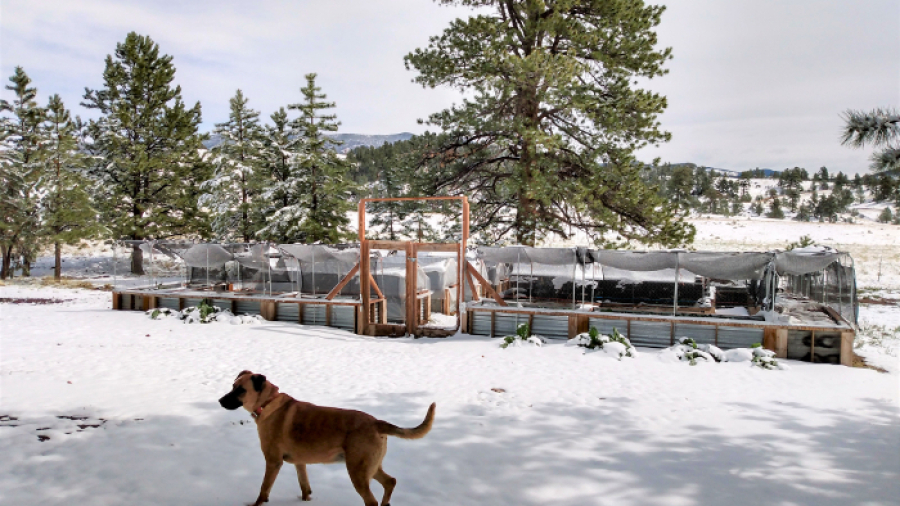
On another note, I don’t know how these other bloggers manage to produce blog content throughout the summer when they are busy in the garden. I obviously don’t do so well at that. But, soon I hope to catch up and provide new insights to growing food at 9,000 feet.

SNOW IN JUNE

SNOW IN JUNE ?!?!?!?

If that’s a question, the answer is YES. It can snow in June here in the Rockies. On Tuesday morning, June 9, we woke up to 2-4″ of soggy snow. It was pretty windy overnight so the snow drifted to make it hard to measure exactly how much. On the average I’d say there was a good 2″. The overnight low temperature was 29.5°, and was below 32° for about 5 hours.

What about the garden?
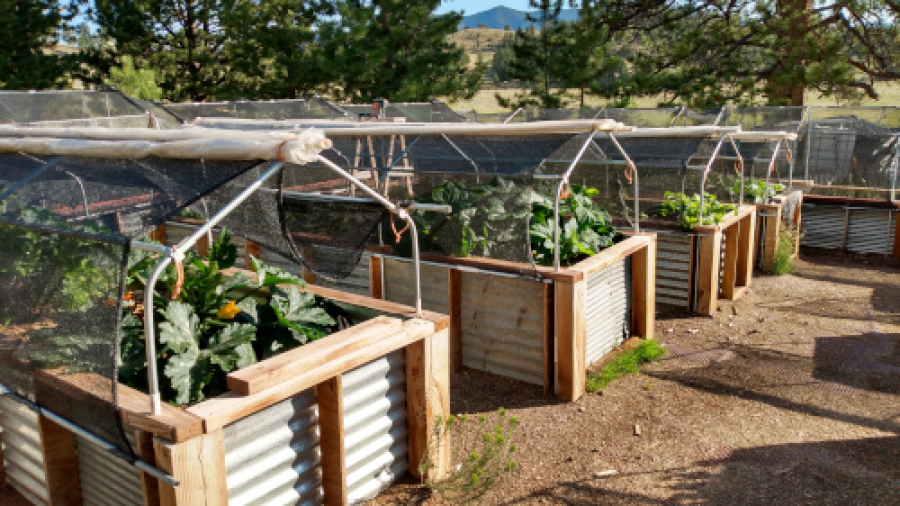
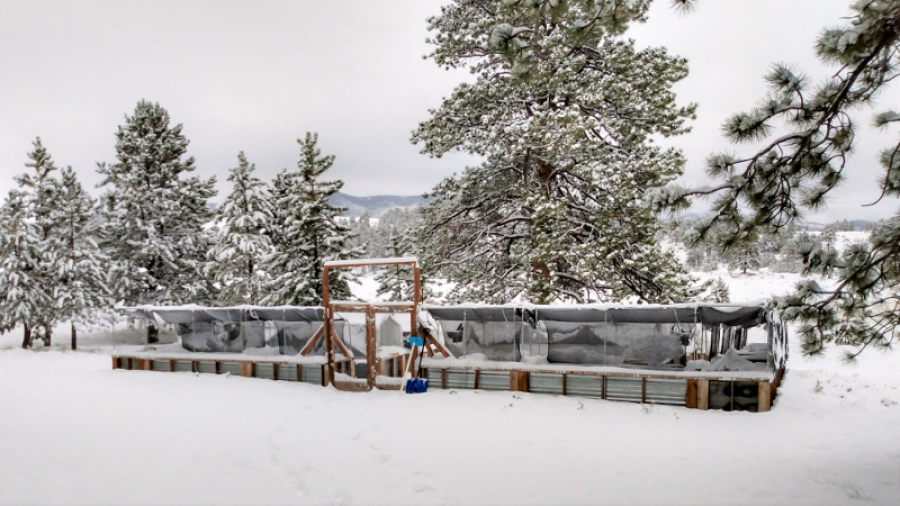
We are well prepared for almost anything, including snow and below-freezing temperatures. We’d seen the forecast, so planned ahead and covered everything as much as possible. Of course, our shadecloth protects not only against the intense sun, but keeps out hail, and in this case, snow.

The most temperate plants (squashes and their companion flowers, and bush beans) are covered each night with plastic over the hoop frames, but on this night we added an additional layer of frostcloth directly over the plants inside those hoops. We have been covering many of our plants with various plastic containers at night primarily to keep the mice out, but in this case they provided extra protection from the cold and snow. The potatoes and other beds with cold-sensitive plants were all covered with frostcloth underneath the shadecloth. Additionally the smallest, most immature plants that do not have plastic over the hoops had water bottles placed around them for added protection against the cold, with frostcloth layed over the top.

In the morning we removed the snow from the shadecloth & frostcloth and opened up the hoop tunnels. By the afternoon, just about all the snow had melted and it reached 53°.

Everything seems to have survived and is doing well!

EARLY SPRING

EARLY SPRING 2020

MAY 25, 2020 - BEGINNING TO "GREEN UP"

I know most folks wouldn’t call this “early” spring, but here in the mountains it’s still early. Because our average last frost date is sometime around June 10-15, I need to be careful about what is planted outdoors prior to that time. In the past I have started a few beds of veggies around May 15, I’ve kept them covered through at least the end of May, with the ability to throw on some frost cloth up to the end of June. (In 2018 and 2019, the last day of 32° or less were 6/25 and 6/23, respectively.)

This year, we had such nice weather the last week of April, including warmer nights, I decided to go ahead and transplant the things that were ready in the greenhouse. I was glad I’d started a few things plenty early! So, the last week of April I transplanted some broccoli, broccolini, brussels sprouts, cabbage, cauliflower, kohlrabi, kale, lettuce & spinach. All were covered nightly with the plastic we have prepared to roll down over our hoops at night, and plastic bottles filled with water are placed around the plants for added warmth. They soak up the sun and heat up during the day to release that heat to their nearby plants at night. I also sowed some peas & parsnip seeds in the ground, and kept those beds covered with frost cloth.

All those things were doing nicely, UNTIL…. MICE got into one of the beds, then three nights in a row the temperature dove to 18-21°. 

MICE
This is the first year we’ve ever experienced a problem with mice in the garden. We always knew that mice would be the only thing that might get through our defenses..it just hadn’t happened. On May 5 I went out to discover that 2 cabbages and 2 broccoli had all been chewed pretty well. Guessing it may have been mice, we put out a trap the next night we didn’t catch one, but the trap had been sprung. The third broccoli in that bed, and the two cauliflower were chewed. The following night sure enough, one squashed mouse was found in the morning. We began setting two traps nightly and set out some D-Con bait traps as well. I cut out the bottoms of some plastic bottles and began setting them over the plants at night. The mice also ate some lettuce & bok choy, but not the spinach or the chinese cabbage. Surprisingly, one morning I found that they’d eaten several onions in another area at the far side of the garden. I’d read that mice did not like onions–not so! At this time, traps are still set nightly with an occasional casualty, and the D-Con seems to have sent a few mice to our ducks’ pool looking for a drink of water and finding a watery drowning instead. It appears that the cabbage and broccoli survived their torture; however, the two cauliflower were too well chewed to come back. Now, for all things transplanted to the perimeter beds, they are covered with bottles, which seems to work well both to keep out the mice and the cold.

COLD
As mentioned previously, we had a few particularly frigid nights. All the plants seem to have survived, but lost a couple of their earliest leaves and were probably set back some. The plastic coverings and water bottles can only do so much to keep out the cold. Perhaps some added frost cloth directly atop the plants would have helped on those coldest nights. It didn’t help that I forgot to cover one of the brussels sprouts on one of those nights! It seems to have survived, but is not near as healthy as those that were covered. All the spinach and lettuces handled the cold just fine.

PLANTS IN THE GROUND
In addition to the things planted the end of April, I gradually have added potatoes, onions, beet transplants and a second round of most of the brassicas and peas. Please read more about the ONIONS & GARLIC started in the fall that didn’t make it and those that did. I have a new onion experiment for 2020. 

Since none of our BERRIES did well, all have been removed. Those beds are now filled with potatoes, since they also like acidic soil. That left we with more bed space for other things where I had originally planned to put the potatoes, so we will be enjoying more of what grows well: brassicas (broccoli, broccolini, cabbage, cauliflower and for the first time brussels sprouts), carrots, peas. I tried some BROCCOLINI in the greenhouse over the winter, and it was a hit! I now have quite a bit of it started outdoors for a continual harvest for as long as it lasts.

PLANTS NOT IN THE GROUND
Started in the greenhouse but not yet ready for transplant are winter squash, summer squash, melon, celery, basil, cilantro, caraway, dill. I will sow carrot seeds this week and beans maybe the first week of June. All these things require more warmth and will wait until it’s safe. The greenhouse keeps our tomatoes, peppers, cucumbers and more squash in the summer months.