2017 july 1100

LATE AUGUST PROGRESS: 2017

It’s time to update the progress in the garden, which I have been putting off because:

  1. I’m too busy working in the garden to spend time writing, and choosing & editing photos.
  2. I’ve thought that what anyone wants to see is results. Results won’t fully be in until the end of the season.
  3. It’s a big project and somewhat overwhelming.

But, I have several observations to share near the end of our first season of high-altitude gardening. Some things have gone well, others have not. I realize that even when I am a “seasoned” high-elevation gardener, every year will be different and will bring different results.


WEATHER

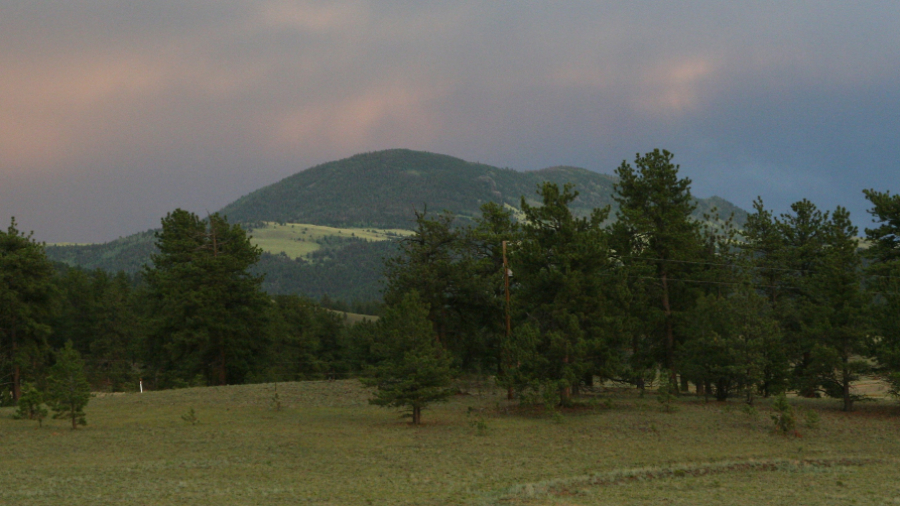
This summer, after some very hot days the latter part of June and early July, we have since had an extraordinary amount of rain and generally cooler weather. And I mean “extra-ordinary”; it has rained almost daily. We had 25 days with rain the month of July, and all but 4 days so far in August have had rain. We’ve had a total of 10.6” during the months June-August, which is a lot for our location. Last year we had 1.8” during that same time period. Some days are sunny and quite warm in the morning, then cooler and cloudy/rainy in the afternoon. Some days we’ve had close to 1” of rain in a day, occasionally with small hail. Other days are just a few spits. Needless to say, I have not had to water the garden much. This photo was taken just after a thunderstorm, showing the typical dark sky and that lush green pasture we have this year.


SHADE CLOTH

The garden beds are almost always covered with shade cloth. The sun is so intense at 9,000 feet, we felt it was important to provide protection. Think “sunscreen” for plants. One concern about the shade cloth would be, “can the pollinators get in?” Yes, the ends of each bed are open, and they should be able to get in and out easily. The birds certainly have figured that out! No worries about the plants getting enough rain, either. The rain still gets through and the hail does not. Some of the hail will sit on top, and as it melts, it drips through to the beds. The shade cloth has been a great addition, and the plants are certainly not suffering from lack of sunshine.


UNIQUE HIGH ELEVATION TIMING 

To some extent, I don’t know if we’re “on track” regarding timing. I think that most things are maturing much more slowly than they would in a warmer climate. I’m not yet sure if things will ripen before the temperatures dive in September. This is a photo of our tomatoes today. I just noticed that these had begun to turn orange yesterday. As an example of our timing here, this is a Glacier tomato, with days to maturity listed as 55. This is my first tomato with any color, shown 74 days after transplanting outside. I was already picking ripe tomatoes at this time where we used to live, although the bulk of them didn’t ripen until September. The only winter squashes I have on the vines are roughly the size of a golfball. At this point, I’m not thinking they will mature before the frosts begin in September. Just about everything is a month behind here, which makes sense, as our last frost date is also a month behind. For the most part I have chosen varieties that should mature as quickly as possible.


PESTS 

The only pests I have had any trouble with have been grubs, aphids, and a few cabbage worms. Not bad!

The grubs showed up in the soil in probably the thousands. As I was digging through one of the unplanted beds one day I began finding them. The more I dug the more I found. I counted as I removed them, and estimated 4-500 in the top 5-6” of just one bed. I threw them all in a bucket and fed them to the ducks a couple of handfuls at a time, and at least they liked them. Although I didn’t observe any obvious plant damage, I was concerned that all these grubs might become some kind of beetles that I wouldn’t want around (beetles that would lay eggs which would become more grubs next season and then more beetles). I wasn’t sure if they would eventually damage the veggies, or not. My best guess is that beetles laid their eggs in our pile of horse manure that had been aging for a couple of years—apparently they love that stuff, and I found that the remainder of that pile was also full of grubs. To get them under control I got some beneficial nematodes, and within a couple of weeks they were largely gone. There are still a few here and there, but they are no longer bothersome.

Bumble Flower Beetle

Just the other day I noticed a beetle buzzing by me, and remembered that during my grub research I had seen photos of a “Bumble Flower Beetle” that looked like this photo. I now think that the grubs may be these beetle larvae, and more beneficial than damaging. There were so many of the grubs, it’s probably just as well that they are under control, but it just may be that they never were that much of a threat.

Aphids have found us and have been eating lettuces, kale and spinach. Not too badly, but they are there and laying eggs. I have sprayed them intermittently with neem and insecticidal soap, which seem to help. I had some calendula planted in a couple of spots, which I removed because they had gotten too big for their locations. When I pulled them up, I discovered that they were covered with aphids, so they may have acted as a “trap” for them, keeping them away from the vegetables to some extent. Off to the compost pile.

The cabbage worms have been present, but not in too many numbers. The same spray has been helpful to keep them at bay. I found one on my corn the other day, but none over there since then.


GREENHOUSE PLANS

Our current project is building a greenhouse. I’ll add another post on that at a later date. Tim’s been working hard to plan and has begun to build our winter oasis. The greenhouse will be attached to the southern side of our house, under and out from the deck. It will have approximately 110 sq.ft. of bed space, and an area for starting seedlings. It will be heated with radiant heat in the concrete floor, and will have a pond inside for thermal storage and for fish–I’ll be able to use the fish’s water to water the plants. It should be enclosed (we think) in about 4-5 weeks, with the heating in the floor to come later . Therefore, I’m already starting some seedlings indoors that will be planted out as soon as I can. Wow! Can’t wait!


IT’S BEEN 74 DAYS: HOW ARE THE VEGETABLES DOING?

It is now 74 days after “last frost”, when most plants were planted outside, give or take a day or two.

The cold-hardy vegetables have all done very well up to this point (brassicas such as kale, cauliflower, mustard; lettuces, spinach, beets, radishes, onions). I’ve started a second batch of all of these to extend into the fall, with covered beds as needed.

Some other vegetables that I expected to do well haven’t met my expectations, such as peas & beans. The peas are there, but not in the numbers I had in our previous garden. The beans have lots of blossoms but very few beans.

The warm-season vegetables that I’m experimenting with are still questionable, such as corn, squashes, and tomatoes. Tomatoes have just begun to turn yellow and orange, the corn has ears that are small and don’t feel like they have much inside, the squashes are small and I doubt they will ripen in time.

Perennials in their first year of growth are (I think) slowly growing, as to be expected. These are asparagus, blueberries, raspberries and strawberries.

At the end of the summer I’ll post all my observations of everything I’ve planted, I’ll do a page for each vegetable or vegetable group to keep it a bit organized. Hopefully the information will help anyone interested.

Building the Garden

APRIL 2017 GARDEN PREPARATION

It’s springtime, and although there is certainly more snow to come, the garden process has begun! Tim is busy clearing the area where we will have our raised-bed fenced garden, and Laurie is busy planning and starting seedlings indoors, under grow lights. It’s a big, exciting year for us, and we look forward to planting, tending & harvesting!


FIRST THINGS FIRST

For the past couple of months, I (Laurie) have been planning what to grow, where to put it, and when to start each plant. For the past few years I have been using the Garden Planner found on GrowVeg.com, which has been a handy tool for planning where I will put each plant each year. After several revisions, our garden plot will look something like this. Some beds will remain empty until mid-summer when we will plant for fall. One of the beds will be filled with cover crop plants, some of which will go to the compost pile. We’re going to call this a “learning year” and try not to go overboard. 🙂

RAISED BEDS

The raised beds will be about 26-28” tall, . Because we need to fence out deer, rabbits, and other roaming critters, the garden will include an additional 4-6′ of fencing starting at the top edge of the perimeter bed and extending upward. Since the garden will be filled with the high, raised beds, we don’t feel we need a terribly tall fence, as the deer won’t want to jump over into a place with such unsure footing.

Richardson’s Ground Squirrel

Each bed will be lined at the bottom with a layer of rocks and gravel (which we have a lot of here in these “rocky” mountains). We believe that this will not only provide some good drainage under the soil, but should also keep these prolific ground squirrels from burrowing up into the beds. They are everywhere around here: digging, burrowing, running across the roads. Some folks call them “picket pens” or “pocket gophers”, we just call them squirrels. We have observed that the squirrels are absent from the area behind our house where there is a lot of this rocky/gravelly stuff, and our assumption is that it’s just too heavy and thick for them to get through. At least, we haven’t seen evidence of them burrowing through it. Our second line of defense against these guys will be a layer of stucco netting, which is a LOT cheaper than the hardware cloth which is often recommended as protection from ground squirrels. Any long roots should still be able to penetrate both the stucco netting and the rocky bottom. Additionally, just to the inside of the perimeter beds, there will be a layer of plastic lining the walkway, to keep both the weeds and the squirrels out.

GARDEN SITE PREP

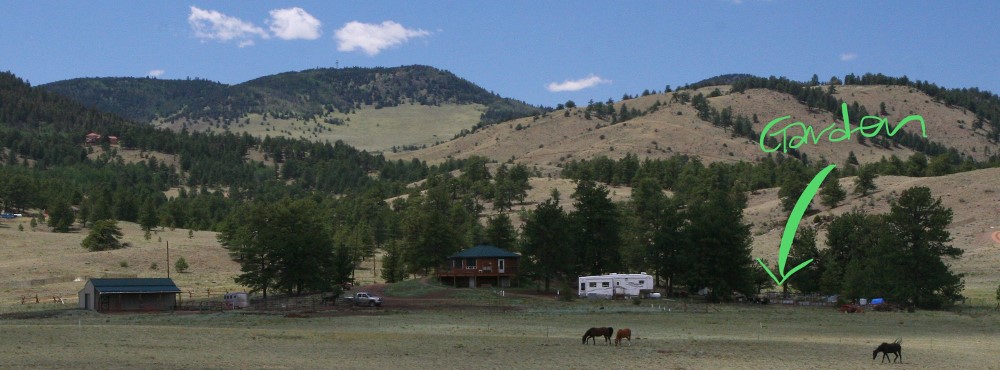
This is a shot of the garden site, the morning of April 19, 2017. Although we have 40 acres, most of which is pretty flat with no trees, we are placing the garden here, in a protected spot from wind, and where plants may get a little shade in the afternoons. The area gets full sun from the E-SE all morning into early afternoon. We feel this site will be best, to protect them from the full effect of the intense sun at our elevation. It is also relatively close to the water hydrant. Tim has begun clearing the area and is building the raised beds. The garden itself will be 41 x 35 feet in size, a little over 1400 square feet. The actual planting bed space will be 740 square feet. There is some slope on this site, so it will be terraced a bit along that slope. The entrance to the garden will be wide enough for the tractor to fit through, which has been and will continue to be a big help. The beds will be filled with a soil combination of natural soil, well-aged horse manure, used duck bedding, some additional organic matter and compost.

LET THERE BE LIGHT

In addition to planning the physical garden, Tim has put together a potting bench area and grow lights under the house in our crawl space. It’s not real pretty down there, but functional. The sink and potting area are helpful for me to mix and prepare the soil blocks I use to start seedlings. Under these lights, I already have started several things; mostly greens for the cold frame section which will be planted mid-May, onions and a few other things which take a long time to get started. The lights can be raised as the plants grow. If necessary, we have more lights that can be placed on the lower side of this bench.  (See more about my soil block approach HERE. Soil blocking supplies can be found at GrowOrganic.com or JohnnySeeds.com.)

WEATHER CONSIDERATIONS

Our official “Last Frost Date” is about June 9. The closest listing is for an area about 500 feet lower and 20 miles away, as the birds fly. Our frost date may be a bit later. In the past couple of years our June lows ranged from 33°F (June 14th) to 50°F. Our USDA Plant Hardiness Zone is officially 5a, but I don’t believe it. Most locals say that we are at least in the Zone 4 range, and some suggest not planting anything that can’t survive Zone 3. I’m generally considering we are Zone 4, and that if I want to try warmer season plants, they will need considerable care and protection from the cold. Our highest low temperature the past couple of summers was 50 degrees, and only for a couple of days each summer. Yes, I will try to grow tomatoes! They will be covered EVERY NIGHT and will be surrounded with jugs of water to keep them cozy and bricks around the base for added soil warmth. Almost all the beds will have the ability to be covered, and anything that requires more warmth will be covered most nights. It also hails here, so I will be prepared to provide cover leafy plants from those icy pellets which are sure to descend.

VEGGIE VARIETIES

This year I will be planting several things, to see what will grow and what won’t. I’m even planning to try things that may not make it, just to see what happens. I’m sure that cool-season vegetables shouldn’t have a problem. It’s the warm season ones and those that need a longer season that are in question. By starting things indoors ahead of last frost and protecting them against the elements, I am hopeful for success!

Rhubarb Spring Growth

Here’s my list: alliums (a variety), beans (bush & pole), beets, brassicas (kale, mustard, cauliflower for now), carrots, herbs (annuals & perennials), corn (a cold-hardy short-season variety), greens (including arugula, lettuces, endive, radicchio, spinach, swiss chard), peas, peppers, rutabagas, squash, tomatoes, asparagus, raspberries, goji berries, and finally, rhubarb, which has been in the ground since late 2014 or early 2015. Later on I may provide a list of the specific varieties I’ve chosen.


IMG_5210

THE GARDEN SITE

We’ve begun planning for our new garden, which should be well in place and ready to go in Spring and Summer 2017. We have been reading up on high-altitude gardening, looking for information about what to grow, where to grow it, when to start and how to do it. We want to know what to plan on and what to be prepared for.

South side of the house

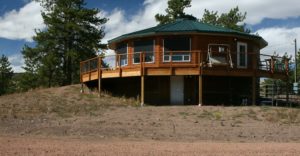
Conventional thought suggests that gardens should be on the south side of the house in full sun. That’s what all the books & websites will tell you, right? So, this is where it was going to be–beds primarily in front of the house (facing south) and terraced down on the left (west) side of the house. The greenhouse is planned to be in front of the deck on a southeast section.

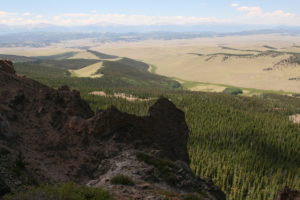
Looking West from Black Mountain shows northern slopes lush and south-facing slopes bare.

However, after observing what the summer conditions have been like our first two summers here, and reading of some of the challenges faced by other Colorado Rocky Mountain gardeners, we’ve changed our opinion and won’t be putting the garden directly on that south facing slope. We also have observed that on most of the slopes around here, the south facing sides are often quite barren of trees and vegetation, while the northern facing slopes are lush and green. The photo on the right shows several north-facing slopes full of vegetation and little on the south sides. Shouldn’t we pay attention to that? 

We have decided to place the garden northeast of the house with some trees around to provide afternoon shade. Although the summer temperatures don’t get incredibly high (85 is a rare, hot day here) the intense sun bakes the vegetation, and it has less of a chance to survive. Also, when the winds pick up it dries out the soil quickly, and would do so in front of our house where it is so exposed. At the east it will be a bit protected from the brunt of the wind.

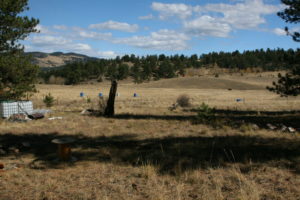
Here’s where the garden will go. This photo was taken on an October afternoon, so there won’t be as much shade in the summer as there is in the photo, when the sun will be higher in the sky. Our garden will get full morning sun and filtered light in the late afternoon. Things that require the most sun will be in the sunniest spots, as much as possible, keeping crop rotation in mind.

This garden won’t be nearly as large as our previous garden, probably less than half that size. (That garden was about 24 beds, about 1400 square feet of planted surface.) We’ll grow a lot of cool season vegetables, and as many short-season varieties of summer vegetables as we feel we can, including some tomatoes. We’ll have to be especially careful to cover the tomatoes nightly, as they’ll need all the warmth they can get. We will be making hoop covers to guard against frost as well as shade/hail covers to guard against the intense sun and occasional hail. Of course, we will have a 7-8 foot fence surrounding the entire garden, lest the deer get into an all-you-can-eat buffet.

I’ve been gathering weather statistics from our weather station the past two summers. Here are my stats for July-August, 2015 & 2016.
The morning “lows” ranged from 34-51F. 
The afternoon “highs” ranged from 52-92F.
In those two years, there were only 7 days with lows of 50 or more. In those same years there were 6 days with highs of 90 and up–all of those were 2016; in 2015 there were none. The average all-day temperature for the summer months has been 59-64F. So, as you can see, many of the plants will require frequent covering, to prevent being too cold in the morning and too hot in the afternoon.

It’s fun to get into gardening mode again. Now that the garden site has been chosen, we have lots of designing and planning to do, and the work will be rewarding.

hclbanner8967.jpg

HIGH COUNTRY LIVING IS LIVE!

My new website, High Country Living.net is now live! There is still a lot to add to it, but I wanted to get it out there.

High Country Living will focus on high-altitude gardening, raising ducks and recipes adjusted for high altitude. It will primarily be instructional, rather than blog-ish, but will also contain a blog featuring what’s new at the ranch.

If you’re looking for information about living at high elevation, particularly in a rural area like ours, glean whatever you can from our experiences.


IMG_5225.JPG

GARDEN PLANNING FOR 2017

We’ve begun planning for our new garden! Tim and I have been reading up on high-elevation gardening, to be aware of where to put the garden, how to lay it out, and what to be prepared for. We want to have a pretty good idea of the big picture soon, as I want to plant what I can before winter sets in, namely onions, garlic and asparagus.

Our first thought was to put the garden on the south side of the house in full sun. That’s what all the books & websites will tell you, right? So, this is where it WAS going to be, beds terraced down on the left side, as well as some in front.

As you can see, plenty of sun on the south side of this house!

However, after observing what the summer conditions have been like the past two summers, and reading of some of the challenges faced by other Colorado Rocky Mountain gardeners, we have decided to place the garden to the east of the house, with some trees around to provide afternoon shade. The sun is so intense here that things will bake in the sun if allowed full exposure. Also, when the winds pick up it dries out the soil quickly, so at the east it will be a bit protected from the brunt of the wind.

Here’s where the garden will go. These photos were taken this afternoon, so there won’t be as much shade in the summer as there is now, when the sun is higher in the sky. The garden will get full morning sun and filtered light in the late afternoon.

This photo looks to the East.


This looks to the West.

This garden won’t be nearly as large as the Wellington garden, but it will be ample, less than half the size. We’ll grow a lot of cool season vegetables, and as many short-season varieties as we feel we can, including some tomatoes. We’ll have to be especially careful to cover the tomatoes nightly, as they’ll need all the warmth they can get. We will be making hoop covers to guard against frost as well as shade/hail covers to guard against the intense sun and occasional hail. Of course, we will have a 7-8 foot fence surrounding the entire garden, lest the deer get into an all-you-can-eat buffet.

I’ve been gathering weather statistics from our weather station the past two summers.
The lowest “low” in July-August was 34 F.
The highest “low” was 51 F.
The lowest “high” was 52 F.
The highest “high” was 92 F.
The average temperature for the summer months has been around 59-64. So, as you can see, many of the plants will require frequent covering!

It’s fun to get into gardening mode again. We have lots of designing and planning to do, and the work will be rewarding.

GUFFEY GARDEN?

As January rolls on and we’ve been receiving seed catalogs and emails from favorite seed companies, I’m itchin’ to start a garden here at our new location near Guffey, CO. Our house is well along the way, and we hope to be able to move in by the end of February. However, the house won’t really be “done”. There will be continuing work to complete the interior, even after we’ve moved in. I’m afraid I won’t be able to do much of a garden this year, and am not yet looking at the catalogs.

I do hope to begin with a few things just to get started, such as a salad garden, and hopefully I’ll be able to get in some perennials, such as asparagus and berries, so they can get a start. It will be fun to determine where to put things and gradually get them going! We do plan on putting up a greenhouse, perhaps in time for fall 2016.

I’ve begun thinking and researching high-elevation gardening, including designing a garden to keep the deer, rabbits and ground squirrels out. There will be much more on that in the years to come.

2015 BREAK FROM GARDENING

I’ve been getting catalogs and emails from several of the seed companies I’ve ordered from in the past, and it’s sure tempting to take a look! Normally this time of year I’d be spending hours planning my garden and deciding which seed varieties I’d like to try. Not this year! 

Even  before we decided to buy our new property we had decided to take a break from gardening in 2015, our seventh year of gardening. It seemed an appropriate time for both ourselves and our soil to rest and replenish. As it has turned out, yes, the soil is resting, we are resting from gardening projects, but not exactly resting! We are now busy planning for our new home and our move to Guffey this spring.


Today we are at the property, staying in our new (temporary) future home, the RV. Tim’s project for the weekend is to put skirting around the bottom to protect it from freezing. It’s nice to be here, and we sure look forward to being here permanently!

GARDEN REFLECTIONS

I have noticed over the years (this was our 5th year of gardening!) that my attitude about the garden is more relaxed.  If something doesn’t make it, I’m a bit sad, but shrug my shoulders and think, “Oh, well…”.   Tim and I have an acronym we say, OWIIWII.  We pronounce it, Oh-wee-wee.  It stands for, “Oh Well, It Is What It Is.”  Some years are better than others, some vegetables do better than others in different years.  

There’s more of a letting go on my part, more peace about what grows and what doesn’t.  There is more trust in God, that I will have what I need, and if I don’t have it I must not need it.  We just take what we get and appreciate what we have. Learning this in the garden transfers to the bigger issues in life as well.  


It certainly is amazing to watch things grow from such small seeds.  I keep thinking about the parables of Jesus, when he talked about seeds, soil and gardens.  Here’s one:

“He told them another parable: ‘The kingdom of heaven is like a mustard seed, which a man took and planted in his field. Though it is the smallest of all seeds, yet when it grows, it is the largest of garden plants and becomes a tree, so that the birds come and perch in its branches.'”  (Mat 13:31-32)

It is so amazing to see these little, tiny seeds and watch them sprout and grow into such huge plants that make more seeds, which make more plants…..  It is like God’s Kingdom.  He does the planting and watering in it, and as we cooperate with Him (obey Him), the Kingdom grows and grows as He desires.  There is peace in knowing that He really is the “vinedresser” with all His wisdom, carefully tending and watching everything work together for His purpose.  He cares about us and His world much more than we do.  We continually look forward to see what all He does with His Kingdom all around us.

If you’re interested in more of our thoughts about His Kingdom, please go to our website, Listen To Him.

Thar’s Voles in my Peppers!

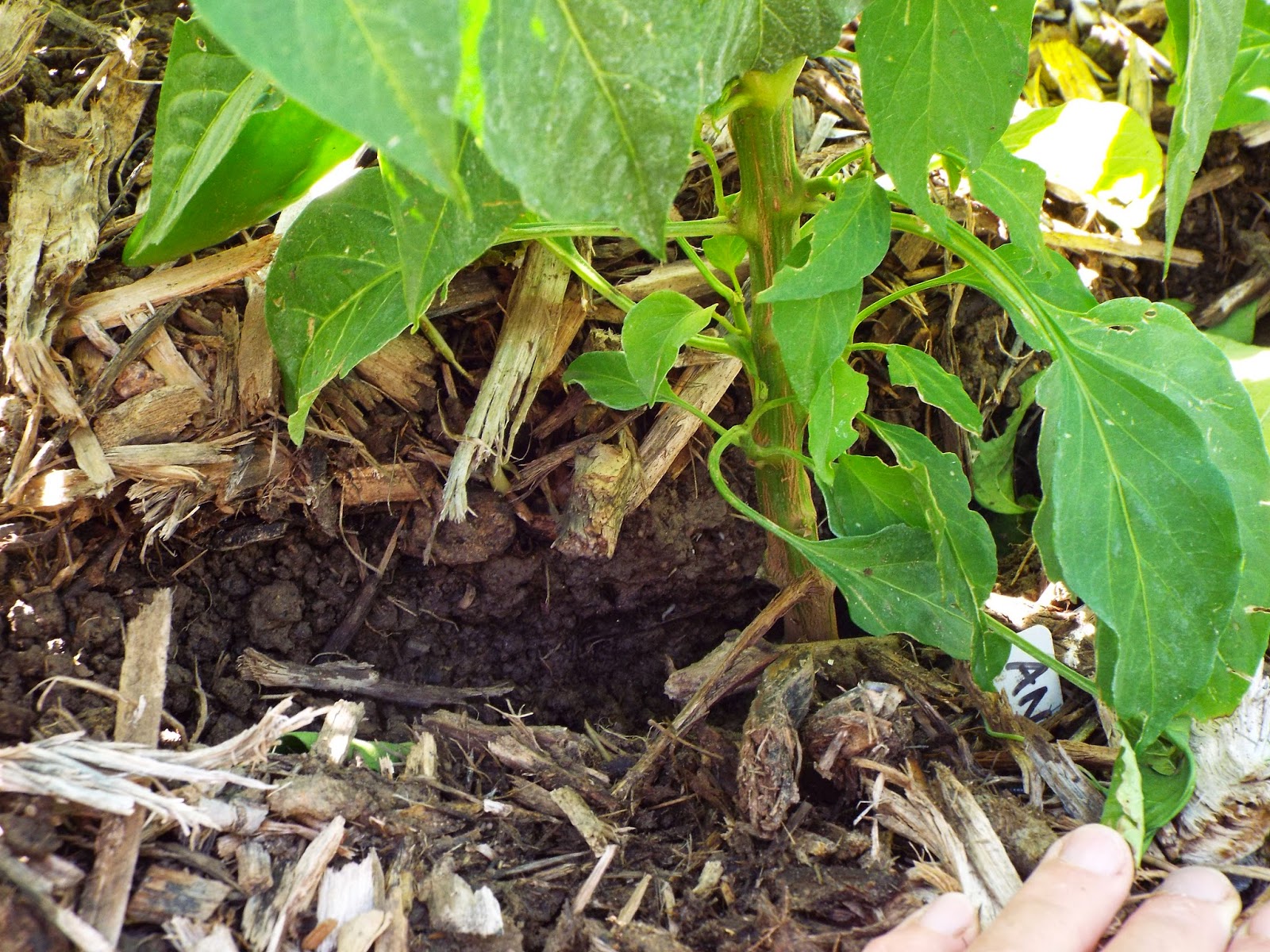
See the trench going under the plant!
I’ve been noticing underground trenches in my pepper bed, starting at one end and on through to the other end.  The holes are about 1 1/2-2″ in diameter, and go under the pepper plants, up again, down and up to the end of the row.  First off I discovered that 6 or so peppers on my only paprika plant had completely disappeared.  Then I found holes and chew marks on some of the anaheims.  Each day I inspected, I’d kick the soil back into the holes.  I’m amazed that the pepper plants are still living, with the holes going right through their roots.
I began researching on the web to determine what kind of critter might be burrowing like this and eating chile peppers.  All I could find was that I should use chile pepper spray to repel them.  Ha!  These guys seem to LIKE the chiles and at first were leaving the sweet peppers alone.  I said, “at first”.  Now, I find chew marks, holes, and half-eaten sweet peppers almost daily.  They really seem to like the peppers, but so do I!  That’s enough.
Yesterday I went out and bought some snappy-type mouse traps and placed them near some of the entrances/exit holes.  Before I ever left the area, in maybe 3 minutes, I’d already caught a vole.  Mystery solved–it IS voles.  Overnight I expected I might catch more, but although a couple of the traps had been snapped, no more catches.  I also bought some castor oil, which is supposed to repel them, so I’ll give that a try, too.  Perhaps I can keep them out of the peppers, but hopefully by just “repelling” them from the peppers, I won’t be sending them off to the tomatoes nearby.
I took a pic of the dead vole in the snap trap, but I’ll spare you.  There’s a nice picture of a cute, fuzzy vole and more information HERE.

Remembering the 2013 Garden

Obviously I have not taken the time to write about the 2013 garden.  Because a few people do read this blog (thank you), I will put in some updates in case they are helpful to anyone.  We learn new things each year as we try various new methods and experience new weather conditions.  Overall, the garden did pretty well, with a few setbacks I will explain in individual posts.  Please see the posts:Garden ReflectionsDeep Mulching, Squash, Tomatoes, Potatoes, Ducks and Cottonwood, Juglone and Tomatoes.  And stay tuned…in the near future I may add some more recipe creations.

December 10, 2013

To start off, this is the garden today.  The past week has not reached over 15F or so until this morning. Now it is a whopping 42 degrees outside.  A few days ago it was -18 in the morning.  This is the coldest I have ever experienced since coming to Colorado in 2008.

Our unheated GREENHOUSE may have suffered from this cold spell, and reached as low as 20F a few of these nights.  The largest lettuces and kale don’t look so good, but hopefully the younger ones haven’t died and will come back and grow nicely.  I have been covering the bins inside the greenhouse with frostcloth overnight, which I think helped, but there’s only so much you can do!  I don’t think this will prevent me from following the same plan in the future.  We just do what we can, and if the weather causes a problem, we’ll live with what we get.

(The old-fashioned way!)

The WEATHER during the growing season was, I think, a bit cooler than usual in June-July, then pretty hot in August and September.  We had our last snow on May 1 (8″), which kept me from planting my early things a bit, but since I hadn’t planned on planting things until later in May, that didn’t cause too much of a problem.  (Our “last frost date” is around May 15, but I’ve begun holding off until after that for many vegetables.)  We had lots more rain than normal throughout the summer, concluding with over 12″ of rain here in September, which was mild, compared to many local areas which suffered from extensive flooding.  Our hearts go out to those who lost homes, crops and livestock.


I like to keep notes on everything I do and record what happens, and this year I found Microsoft ONE NOTE to be very helpful.  In it, I was able to keep easily accessible sections and pages for each plant group, the ducks, the weather, soil amendments, pest control, etc. I also am still using the garden planner at GrowVeg.com to plan my garden spaces.  I find it a handy and fun tool.  In case you missed my March post, the plan for the 2013 Main Garden is HERE, and the 2013 Corn Patch is HERE.


I’ve been getting most of my seeds from Botanical Interests and High Mowing Seeds, Peaceful Valley/Grow Organic, and a few from Sand Hill Preservation.  Although I would like to support the small business, Sand Hill, I must be honest that I probably won’t be ordering from them again.  It’s been fun to try many of their unique heirloom varieties, but the seed germination rates from these just aren’t as good as I get from other seed companies.  I wasted a lot of time and energy trying to get their seeds to grow.  Next year I plan to check out Baker Creek Heirloom Seeds for more of the unusual varieties I’d like to try.


SEASON HIGHLIGHTS 

This year I tried several varieties or plants I haven’t grown before: squash, beans, eggplant (won’t do again), fava beans (will do again), a couple of new tomatoes.  My biggest headache was the sowbugs!  Most of my squash died.  Many of my beans didn’t make it.  I had very few strawberries and not as many raspberries & blackberries–we may not have pruned them correctly.  We did get our first harvest of delicious grapes–some green seedless and some red seedless.  After recovering from some damage, hopefully next year our purple grapes will produce.  Our corn was very good this year–I returned to planting some of the organic sweet hybrid varieties (Sugarbaby, Brocade, Sugar Pearl), rather than the heirlooms I did last year, which were ok, but not as sweet and crisp as the hybrids.  

The biggest new thing we did was the deep mulching with wood chips, which is detailed in a separate post.  This was overall a positive change.


PLANNING FOR 2014

It’s time to begin!  I’m receiving catalogs and emails from some of my favorite seed companies offering sale prices and free shipping if I order early, so it’s time to start planning.  

One big change is that I plan to put all my tomato plants out in our NW area previously used as the 3-Sisters Corn Patch.  I’m running out of rotation beds in the main garden area for tomatoes, peppers & potatoes, so I’ll try the tomatoes in a whole new area, and put the corn in the main garden.


We will continue deep mulching, combining manure & compost with the wood chips and watering less frequently.